
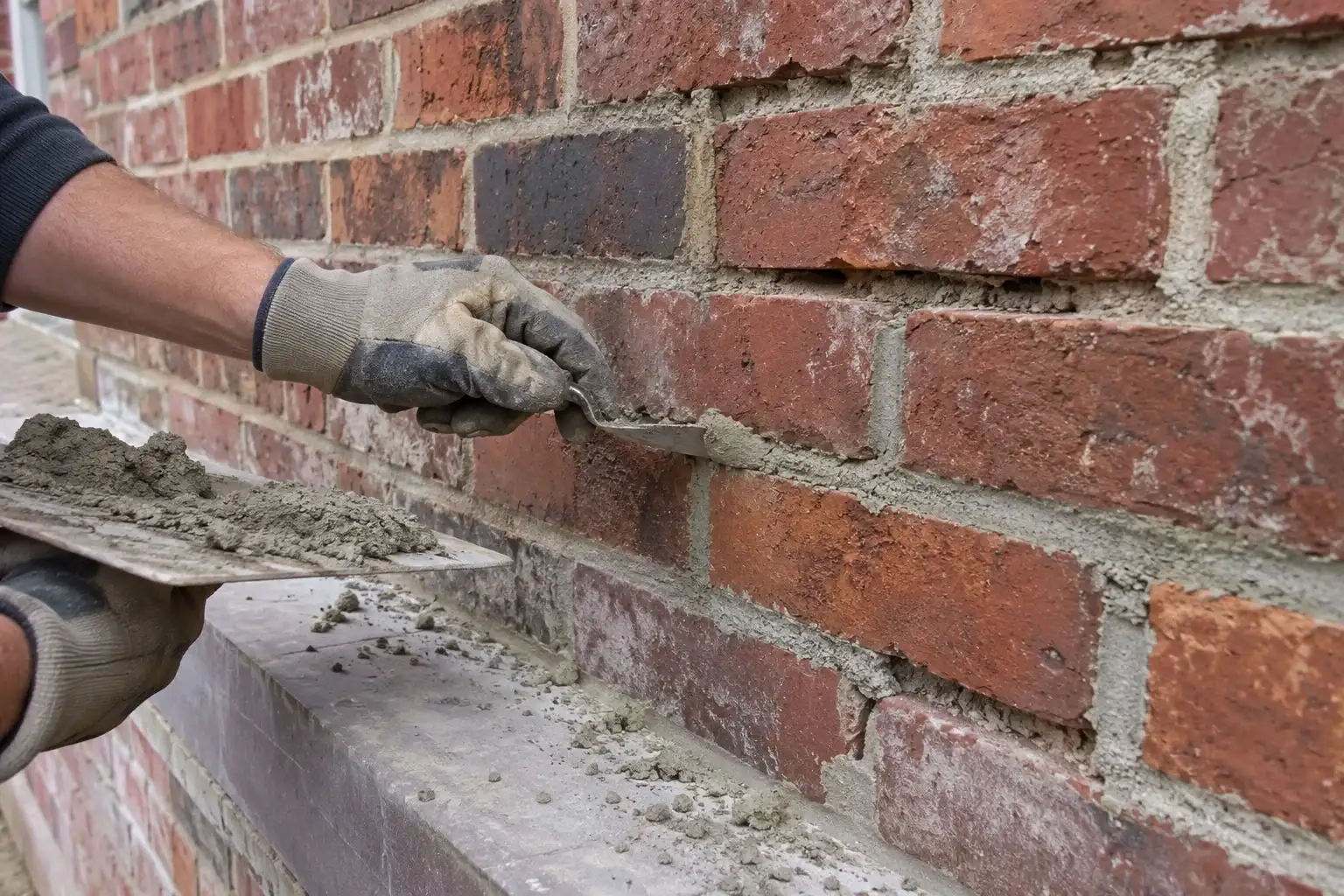
Tuckpointing & repointing
Tuckpointing & Repointing in St. Peters, MO
When mortar joints crumble, crack, or wash out, water gets into the wall. We remove the failing mortar and repoint the joints with a mix matched to your brick in color, strength, and texture.
What tuckpointing is, and how it differs from repointing
Repointing means removing deteriorated mortar from the joints of a brick or stone wall and replacing it with fresh mortar. Strictly speaking, tuckpointing is a finishing technique: the joint is filled with mortar colored to match the brick, and a thin line of contrasting mortar is “tucked” into it to create a crisp, narrow joint.
In everyday use (and in most quotes you’ll receive) both words mean the same job: taking out failing mortar and pointing the joints back in. On this page, “tuckpointing” covers the whole service. If your wall has a traditional tuck-and-point finish, we’ll tell you and quote it that way.
Signs your mortar joints need attention
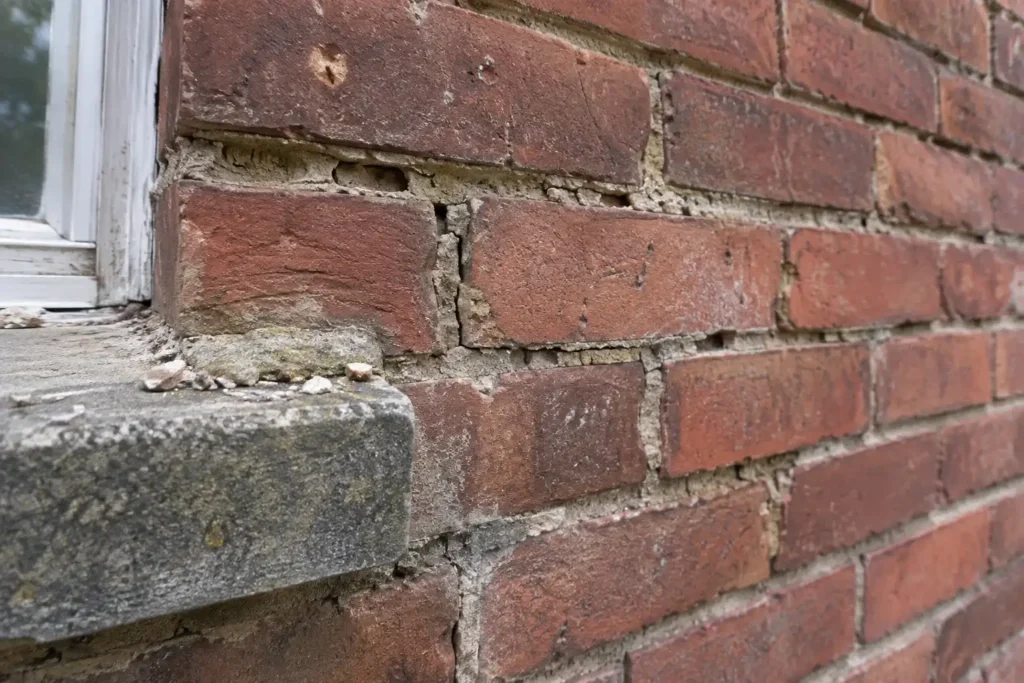
Mortar is meant to wear out before the brick does. These are the signs it has reached that point:
Recessed or hollow joints
Mortar sitting noticeably behind the brick face, or joints you can scrape out with a key.
Cracked or crumbling mortar
Hairline cracks, sandy grit at the base of the wall, or pieces falling out.
Gaps around brick
Visible voids, especially near chimneys, window sills, and corners.
White staining
Powdery white deposits (efflorescence) mean water is moving through the wall.
Dampness inside
Stained drywall, musty smells, or peeling paint on walls behind exterior brick.
Loose bricks
Bricks that shift when pressed have lost their bond, see brick repair and replacement.
Why mortar fails on St. Peters homes
Most mortar failure comes down to water. Rain soaks into porous joints, and when temperatures swing above and below freezing, that water expands inside the mortar. Missouri winters bring many of these freeze-thaw cycles, so exposed walls, chimneys, and the tops of garden walls usually deteriorate first.
Other common causes are clogged gutters or downspouts that dump water against the wall, sprinklers hitting brick, earlier repairs done with mortar too hard for the brick, and plain age. For the weather side in more detail, see how freeze-thaw cycles damage brick and mortar.
How the tuckpointing process works
Inspect and scope
We look at the joints, the brick, and where water is coming from, then recommend spot repair, a full wall, or a whole-house repoint.
Match the mortar
Mortar type, sand, and color are selected to suit your brick. Older, softer brick gets a softer mortar.
Remove failing mortar
Joints are cut or raked out to a consistent depth (typically about two to two-and-a-half times the joint width) without widening joints or chipping brick edges.
Clean and dampen
Dust is cleared and joints are lightly misted so the brick doesn’t pull water out of the new mortar too fast.
Repoint in layers
Mortar is packed into the joints in lifts, then tooled to match the existing joint profile.
Cure and clean up
New mortar is protected from sun, rain, and frost while it cures, and the wall is cleaned of residue.
What to expect while the work is underway
Cutting out old mortar is the loud part. Grinders and chisels make noise and dust for the first stretch of each wall, then the job gets much quieter once pointing starts.
Before we cut, plants along the wall get covered, windows on that side should stay shut, and cars are best moved away from the work area. If you have pets that react to noise, plan on keeping them inside or away from that side of the house for the day.
Mortar and joint options
The right mortar isn’t the strongest one. It should be slightly softer and more flexible than the brick, so that if something has to give, it’s the joint, not the brick face.
Type N mortar
The general-purpose choice for above-grade exterior walls.
Best for: Most brick homes built in recent decades.
Type S mortar
Higher strength for below-grade work and heavier loads.
Best for: Foundations, retaining walls, site walls.
Lime-rich / Type O mortar
Softer and more breathable; protects softer brick.
Best for: Older and historic brick, see masonry restoration.
Joint profile & color
Concave, V, flush, raked, or struck joints; sand and pigment adjusted to blend with weathered mortar.
Best for: Every job. New joints look fresh at first and settle in with weathering.
Spot repairs, full walls, and chimneys
Not every wall needs repointing at once. If deterioration is limited to a chimney, a parapet, or the side of the house that takes the most weather, spot repointing is a sensible, lower-cost fix. When failing joints are spread across a wall, repointing the whole elevation gives a uniform look and avoids repeated patching.
Chimneys take the worst of the weather and are often the first place joints fail. Chimney repointing is covered with crowns and caps on our chimney repair page.
How long tuckpointing lasts
Well-executed repointing with compatible mortar typically lasts decades; commonly cited ranges run from about 20 to 30 years or more. How long yours lasts depends on exposure, drainage, and whether the underlying water problem is fixed.
Joints on sheltered walls can far outlast those on chimneys, wall caps, and surfaces hit by sprinklers or overflowing gutters.
Caring for new mortar
Fresh mortar hardens within a day or two but keeps curing for weeks. For the first month:
- Keep sprinklers off the repointed wall
- Don’t pressure-wash or scrub the joints
- Expect the color to lighten a little as the mortar dries and cures
- Tell us if you see hairline cracks or crumbling in the new joints
What affects the cost of tuckpointing
We price after seeing the wall. The main factors:
- How much of the wall needs work, and its total area
- Joint width and how hard the old mortar is to remove
- Height and access: ladders, scaffolding, roofs, landscaping
- Mortar matching, especially on older brick
- Related repairs, such as replacing cracked or spalled brick
- Chimney work and roof access
Keeping mortar joints in good shape
- Keep gutters and downspouts clear and pointed away from brick
- Adjust sprinklers so they don’t wet the wall
- Walk the house each spring and look for recessed joints and cracks
- Don’t pressure-wash brick. It can blast mortar out of joints
- Avoid non-breathable sealers that trap moisture in the wall
- Fix small failures early, before water reaches the brick behind
Related guide
Thinking about doing it yourself?
Small, low-risk patches can be a homeowner project. Our guide explains when DIY mortar repair works, and when it creates bigger problems.
Related services
Masonry & Brick Repair
Fix cracked, spalling, and loose brick, block, and stone, and the cause behind it.
Chimney Repair
Crowns, repointing, rebuilds, and fireplace masonry, stopping leaks at the source.
Masonry Restoration
A coordinated plan for aging and historic brick and stone, done with compatible materials.
Especially relevant in:St. CharlesUniversity CitySt. Louis
Questions about tuckpointing
Is tuckpointing the same as repointing?
In most quotes, yes. Both mean replacing deteriorated mortar. Traditional tuckpointing also adds a thin contrasting line of mortar to create a crisp joint. We'll tell you which your wall has.
How do I know if my house needs tuckpointing?
If you can scrape mortar out with a key, see gaps, notice joints recessed more than about 1/4 inch behind the brick face, or find sandy grit at the base of the wall, it's time to have it looked at.
When is the best time of year for tuckpointing in Missouri?
Spring and fall. Mortar shouldn't be placed below about 40°F or when frost is expected shortly after. Summer work is fine with shading and misting to slow drying.
Will the new mortar match my old mortar?
We match color, sand texture, and joint profile as closely as possible. New mortar looks slightly fresh at first and blends in as it weathers.
Can tuckpointing stop water leaks?
It closes one of the most common water paths. If water also enters through cracked brick, failed flashing, or a chimney crown, those need attention too.
How long does a tuckpointing job take?
A single chimney is often a day or two of work. A full house can take one to several weeks, depending on its size and height, how much mortar has failed, and the weather.
Do I need a permit for tuckpointing?
Like-for-like repointing usually doesn't need a building permit. Homes in a local historic district can be different, so check with the city first if yours is in one.
Can you tuckpoint stone walls and chimneys too?
Yes. Stone joints are repointed the same way, with a mortar suited to the stone. Chimneys are one of the most common repointing jobs we see.
Why not just seal the brick instead?
A sealer doesn't fill open joints, and many sealers trap moisture inside the wall. Repoint first. A breathable water repellent can be considered afterward on very exposed walls.
Questions about tuckpointing? Call and talk to a mason.
The fastest way to get answers is a phone call. Mon to Sat, 8 AM to 6 PM · Sun, 10 AM to 2 PM
Prefer to write? Send a message
For the quickest answer, call (669) 326-4536. Otherwise, leave your details and we’ll get back to you.
Hours
Mon to Sat, 8 AM to 6 PM
Sun, 10 AM to 2 PM
Mon to Sat, 8 AM to 6 PM
Sun, 10 AM to 2 PM